
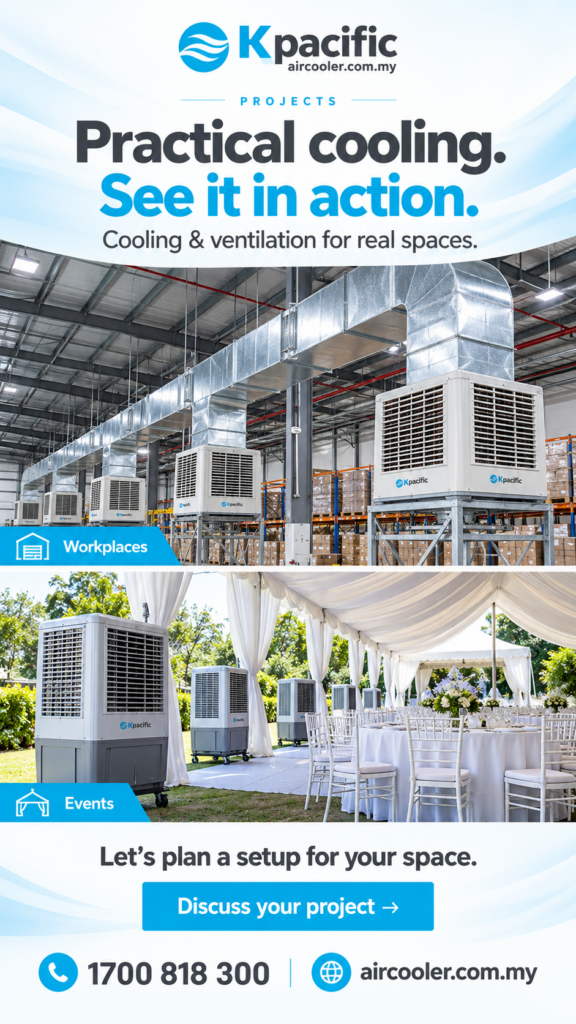
Industrial evaporative air cooling is the most cost-effective method for lowering ambient temperatures across manufacturing plants, automotive workshops, and open warehouses in Malaysia. By replacing recirculated, stale air with continuously filtered fresh outdoor airflow, facilities can achieve temperature drops between 4°C to 10°C while cutting electrical power costs by up to 80% compared to traditional compressor air conditioning.
What is an Industrial Evaporative Air Cooler?
An industrial evaporative air cooler (often called a desert cooler or swamp cooler) is a mechanical ventilation and cooling unit that draws warm outside air through continuously wetted cellulose (Celdek) honeycomb pads. As water naturally evaporates into the passing air, it absorbs sensible heat, discharging chilled, 100% fresh, oxygenated air into open or semi-open industrial workspaces.
The Science: Can Evaporative Cooling Work in Malaysia’s Tropical Humidity?
The single most common objection plant directors and facility managers raise is: “Malaysia is too humid for evaporative cooling.” While this assumption holds true for closed residential bedrooms, it fundamentally misunderstands industrial psychrometrics and how wet-bulb depression works in tropical factories.
Relative humidity fluctuates inversely with ambient temperature:
- Early Morning (6:00 AM): Ambient temperature is 24°C–26°C with 85%–90% relative humidity. Natural cooling is rarely needed at this time.
- Peak Working Afternoon (12:00 PM – 4:00 PM): When your production floor suffers the greatest heat buildup, outdoor temperatures surge to 33°C–36°C. Crucially, as the temperature peaks, daytime ambient relative humidity drops to 55%–65%.
This difference between dry-bulb temperature and wet-bulb temperature (the wet-bulb depression) allows industrial coolers to achieve a consistent 4°C to 10°C temperature drop. More importantly, evaporative cooling is an active-displacement ventilation system: unlike air conditioning, which requires hermetically sealed windows and traps welding fumes, dust, and VOCs, evaporative coolers operate exclusively with open roller shutters and roof exhaust systems, creating continuous positive pressure that pushes stale heat out of the facility.
You can learn more about how air turnover works in our guide on how evaporative cooling works in tropical facilities.
How to Size Your Factory: The Airflow (m³/h & CFM) Formula
Under-sizing industrial coolers leads to poor airflow velocity, while over-sizing leads to unnecessary capital expense. In industrial cooling engineering, required airflow is calculated based on Air Changes per Hour (ACH).
The standard formula used by Kpacific’s engineering team is:
Required Total Airflow (m³/h) = Total Room Volume (Length × Width × Ceiling Height in metres) × Recommended Air Changes per Hour (ACH)
Recommended Air Changes per Hour (ACH) by Industry
| Facility / Workplace Type | Typical Heat Sources | Recommended ACH |
|---|---|---|
| Clean Storage / Logistics Warehouses | Forklift traffic, ambient solar roof radiation | 20 – 25 ACH |
| General Assembly / Packaging Lines | Conveyor motors, medium worker density | 25 – 30 ACH |
| Automotive Workshops & Garages | Engine heat, exhaust fumes, open bays | 30 – 35 ACH |
| Plastic Injection Molding & Tooling | Hydraulic presses, heating bands, high thermal load | 35 – 45 ACH |
| Commercial Kitchens & Food Processing | Ovens, steam kettles, fryers | 40 – 50 ACH |
Practical Factory Sizing Example
Let’s calculate the equipment requirements for a standard Malaysian logistics and assembly warehouse:
- Floor Dimensions: 30 metres length × 20 metres width (600 m² or ~6,450 sq ft)
- Ceiling Height: 6 metres
- Total Volume: 30 × 20 × 6 = 3,600 m³
- Target Air Changes: 25 ACH (general assembly)
- Required Airflow: 3,600 m³ × 25 ACH = 90,000 m³/h
To deliver 90,000 m³/h, this facility would require either 5 units of 18,000 m³/h rooftop side-discharge coolers or 3 units of 30,000 m³/h heavy-duty industrial units. Review our complete industrial evaporative cooler product specifications for model dimensions and fan motor options.
Cost Reality: Evaporative Cooling vs Commercial Air Conditioning
Factory directors often evaluate split-unit or package air conditioners against evaporative coolers. The capital investment and monthly Tenaga Nasional Berhad (TNB) operating bills present a stark contrast:
| Comparison Metric | Industrial Evaporative Cooler (18,000 m³/h) | Package Commercial Air Conditioner (~15 HP) |
|---|---|---|
| Power Consumption | 1.1 kW – 1.5 kW (Single-Phase 240V / 3-Phase 415V) | 12.0 kW – 15.0 kW (3-Phase 415V required) |
| Daily Electricity Cost (12h @ RM0.509/kWh) | ~RM3.66 per day | ~RM27.50 to ~RM36.60 per day |
| Monthly Power Bill (26 working days) | ~RM95.16 per unit | ~RM715.00 to ~RM951.60 per unit |
| Building Requirements | Works with 100% open doors & roller shutters | Requires 100% airtight sealed building |
| Fresh Air Delivery | 100% fresh, filtered outdoor air | Recirculated air (traps fumes and odors) |
| Capital Cost (CapEx) | Up to 70% lower initial equipment cost | High initial cost + complex refrigerant piping |
Operating on standard industrial power, an evaporative cooler consuming 1.1 kW costs approximately RM3.66 for a full 12-hour production shift under standard TNB Commercial Tariff B (RM0.509/kWh). For an entire plant operating 5 units, the monthly power cost is under RM500—compared to over RM4,000/month for equivalent compressor air conditioning.
Rooftop Fixed Discharge vs Mobile Workshop Spot Coolers
Depending on your plant layout, Kpacific provides two distinct configurations:
- Rooftop / Wall-Mounted Side-Discharge Systems: Permanently installed on the factory roof or perimeter wall with galvanized spiral ducting and multi-directional air diffusers. Ideal for production lines, clean packing rooms, and long aisles where uniform temperature drop is required across 24-hour manufacturing shifts. Learn more about our factory ventilation and installation services.
- Heavy-Duty Mobile Spot Coolers: High-capacity portable units with integrated water tanks and multi-directional louvers on heavy-duty caster wheels. Ideal for loading docks, tooling bays, maintenance workstations, or seasonal event cooling. If your need is temporary, explore our air cooler rental fleet across Selangor and KL.
Pre-Installation Checklist for Factory Managers
Before installing permanent industrial coolers, ensure your facility has:
- Water Supply Line: A standard 1/2-inch cold water inlet with continuous water pressure (0.2–0.6 MPa) for automatic sump float valves.
- Power Point: Single-phase 240V or 3-phase 415V isolator within 3 metres of the mounting location.
- Exhaust Relief Path: Sufficient roof ridge ventilators, louvers, or negative pressure wall exhaust fans to allow positive air displacement.
Need a Factory Airflow Assessment?
Kpacific’s engineering team provides on-site airflow calculations, thermal mapping, and duct layout planning for factories and warehouses across Selangor and KL.
- Accurate Air Changes per Hour (ACH) calculation
- TNB electricity bill savings projection
- Rooftop & side-discharge duct design
- Supply, installation & maintenance support
Or call our Puchong rental desk: +60 1700-818-300